The ideas below run from a packet of wildflower seed to the price of a potted dwarf false cypress, and from one afternoon of planting to a multi-season wait while creeping thyme fills in.
What decides which is yours is whether you are working around surface roots you cannot dig through, or soil you can still open with a shovel.
Where the roots are too dense to break, a container of lemon balm or a half-barrel of alpine blueberries does the growing instead.
1. Cyclamen

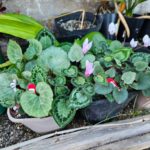
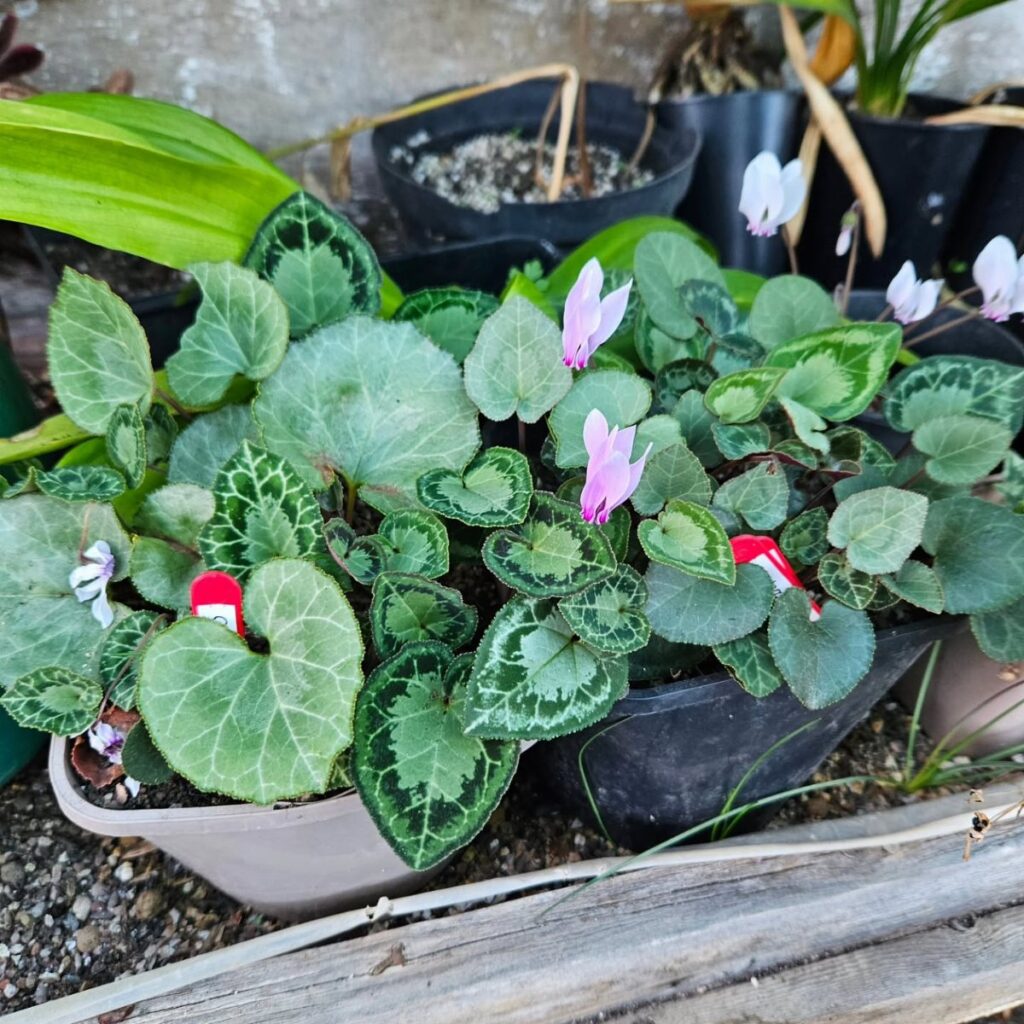
Cyclamen carries two seasons of interest from one plant. The leaves arrive first, marbled with silver and deep green in patterns that read even in dim light, and the flowers follow on short stems in late summer through fall.
I would tuck these under deciduous trees where the canopy is bare when they bloom and leafed out when they need shade.
The tubers sit shallow, so angled or compacted soil under old trees suits them better than deep digging would. They want sharp drainage; a slope that sheds winter rain helps more than any amount of soil amendment.
Check whether your tree is evergreen or deciduous. Cyclamen under a pine stays too dry in summer and too dark in winter.
2. Muscari (Grape Hyacinths)

Muscari spreads into thick colonies once the bulbs find their footing, and that slow takeover is exactly what you want under trees where replanting every year is not practical.
The blue spikes push up in early spring while deciduous branches are still bare, catching light that the canopy will block once the leaves fill in.
I have planted these at the drip line of a maple and watched them hold ground where grass thinned out. They do not mind summer dryness once the foliage ripens down.
Plant in fall, setting the bulbs deep enough to stay anchored through freeze-thaw cycles, in clusters rather than rows so the spread looks natural when it comes. The clumps divide every few years if you want to move some elsewhere.
3. Day-neutral Strawberries

Day-neutral strawberries fruit on and off from late spring through fall, not just in the June flush, which matters when you are stealing light under a tree canopy that will thicken as summer goes.
Albion and Seascape are the two varieties I see mentioned for this kind of spot; both handle partial shade without turning all leaves and no berries.
Black plastic mulch warms the soil and keeps fruit clean under branches that drip after rain.
You get less fruit per plant than with June-bearing types, but the season runs longer. Full sun gives more pounds per plant.
I would use this for a handful of plants near the kitchen, not a production patch, and I would pick day-neutrals over June-bearers for the longer season in low light.
4. Rhubarb

Rhubarb asks almost nothing once it settles in. The red stalks and massive leaves read as ornamental from across the yard, and the plant stays green where winter does not kill it back hard.
I would site it at the edge of a tree’s shade, not deep under the canopy, since it wants some sun to build those thick stalks.
Spring bulbs for early color, rhubarb for the long haul, that is the pairing to copy.
It is deer-resistant, heat-tolerant, and cold-hardy down to zones where little else stays green in January. The leaves are toxic; only the stalks go to the kitchen.
One warning: if you are planting near a property line, check whether the land is yours. Council land or utility easements can mean a removal letter later.
5. Hostas

Hostas solve the problem of what to plant where almost nothing blooms. Size varies enormously from miniature to giant forms, so the choice depends on your scale.
I would put the big ones as anchors and thread smaller varieties between.
They want consistent moisture, which can be hard under trees that drink first. A thick mulch of shredded leaves helps, and I would avoid the southern side of a tree where summer sun bakes the soil between roots.
Slugs are the main pest; iron phosphate bait works if you are not opposed.
6. Lupinus Rivularis

Lupinus rivularis, the riverbank lupine, sends up spires in lavender and soft purple where many plants would sulk in root competition. The palmate leaves look almost tropical against bark, and the flowers draw pollinators in late spring.
I would not spray insecticides nearby; the reason to grow this plant under a tree is the beneficial traffic it brings, and broad-spectrum sprays defeat that purpose.
It fixes nitrogen, which is a polite way of saying it feeds itself and eventually its neighbors. That helps under trees where the soil is tired.
Lupines germinate irregularly and resent transplanting, so direct sowing in fall or very early spring works better than nursery pots.
I would scratch seed into cleared soil and wait, rather than fight to keep a purchased plant alive where roots dry fast.
7. Creeping Thyme

Creeping thyme spreads into a dense mat that stays low enough to duck under most tree branches without fighting them for height. Creeping thyme carries a mint-herbal scent that rises when you brush past it on a path.
It wants the thin, dry soil that trees often leave behind, and once it fills in, it chokes out weeds that would otherwise colonize those bare spots.
My call: this one suits the reader who wants ground cover without installing landscape fabric or refreshing mulch every spring.
You will wait longer for it to fill in than you would with mulch or fabric. It fills in faster with full sun, so under a dense canopy it spreads slower and the bloom is sparser.
Check how much midday light actually reaches your spot before you buy flats.
8. Butterfly Weed

Orange butterfly weed reads as a wildflower but behaves more like a stubborn perennial once it finds its footing. It holds its own in tall grass, which tells you something about its tolerance for competition.
Well-drained soil matters more than perfect sun; in clay that stays wet, the taproot rots. I have seen it thrive at a tree line where the canopy thins to dappled light and the ground dries between rains.
It self-seeds freely once established, so the color drifts year to year. That suits the meadow-style planting, less so a formal bed.
For readers who want reliable monarch habitat without coddling seedlings, this is the milkweed that forgives neglect.
9. Egyptian Onions

Egyptian onions produce bulblets at the top of their stalks, which is the oddity that earns them space in a garden already growing ordinary scallions from the grocery store.
Transplant the bulbs at starter-pot size; the mature clump spreads wider than what you see in the pot.
They naturalize by dropping those top bulblets and walking themselves around the bed over seasons. Under trees, that wandering habit means they fill gaps without your intervention, though you may need to thin volunteers that crowd each other.
The stalks are tougher than supermarket green onions; I use them in cooked dishes, not raw. For a reader who wants perennial alliums where digging and replanting each year is impractical, this is the set-it-and-check-it option.
10. Garlic Chives

Garlic chives carry white star-shaped blooms that read as ornamental until you crush a leaf and the kitchen smell gives them away.
This is one of the few alliums that pollinators work openly, so plant it where you will see the activity.
They spread by seed and by clump division, so under trees they can colonize the root zone without the full sun that bulbing garlic demands. The flavor is milder than true garlic, more scallion with a backnote of it.
My judgment: plant these where you will brush against them often enough to remember to harvest.
They self-sow aggressively in loose mulch, so either harvest the seed heads before they drop or accept that you are managing a patch, not a row.
11. Coneflowers

Purple coneflowers under a tree edge stay upright longer than in open prairie because the surrounding shrubs break the wind. That structural support matters more than the light level for keeping them presentable through August.
They are drought-tolerant once the taproot finds depth, but that first summer they need water to push the root down through tree competition. Partial shade reduces bloom count; the plant lives but the show thins.
I would plant these for a reader who wants pollinator traffic at the garden’s edge, not under dense shade. You get fewer flowers per stem, though the color still reads from a distance.
Check your canopy density against the photo’s filtered light.
12. Wildflowers

A wildflower mix under trees fills the ecological niche that turf grass abandons once shade and root competition thicken. An established mix runs orange, pink, blue, and white together, none of it planted as individual species in rows.
The minimal-maintenance promise holds only after establishment, which means weed suppression the first two seasons while the perennials develop.
Most commercial mixes lean heavy on annuals for first-year color; those annuals fade and leave gaps if the perennials have not filled in.
I would buy a mix labeled for partial shade, then expect to overseed or spot-plant after year two. Insects you did not plan for arrive once the mix matures.
The reader who wants instant results should spend the money on mature plants instead.
13. Dwarf False Cypresses

A container on a deck or patio gets around digging altogether, and dwarf false cypresses handle the shade and root competition just fine when potted.
Their scale-needle texture reads as a small shrub rather than ground cover, which matters when you want vertical interest under a canopy that blocks most light.
I would check the mature spread before buying; some varieties stay narrow enough for tight spaces and others want more room than a tree root zone leaves behind.
In ground, they tolerate the dry shade between surface roots better than most evergreens because their own roots stay shallow and fibrous. Water the first two summers like you mean it; after that, they coast.
14. Lemon Balm

The scent is lemon-mint sharp, not subtle, and it releases when you brush past or pinch a leaf. For cooking, harvest early in the season; by late July the leaves turn coarse and the flavor follows.
It spreads by seed and runner both, so the container is doing containment work as much as display. Cut it back hard after flowering or it will self-sow into every crack.
15. Alpine Blueberries

Alpine blueberries fruit on a low bush that stays below most shade canopies without fighting for height, and the berries sit right at hand level.
Soil is the real question: they need acidic, well-drained conditions that tree leaf litter sometimes provides and sometimes does not.
I would test the pH before committing; if the number comes back above 6.0, grow them in a half-barrel of peat-based mix instead of amending in ground.
Two plants minimum for pollination, and the birds will beat you to ripe fruit unless you net. The biodiversity note is real: bumblebees work the bell flowers in spring when little else is open under leafless branches.
16. Betony

Betony sends up those vertical purple wands in late spring, and the height matters under trees where most shade plants hug the ground.
I would plant it where you look across rather than down into the bed; the flower spikes read better at knee to waist level than underfoot.
It is a mint family plant without the mint family running habit, which saves you from edging work. The tubular flowers are sized for bees, though hummingbirds will pause at them too.
Deadhead if you want tidy; leave the seedheads if you do not mind self-sowers and winter texture.
17. Sedum (Autumn Joy)

Autumn Joy sedum earns its name in September, when the flat pink heads turn copper and the stems stay upright through light frost.
The succulent leaves handle dry shade better than most perennials because they store their own water, which matters when tree roots have claimed every drop from the soil.
I would split a clump every few years to keep the center from opening up; it takes a spade and little time, and the pieces transplant without fuss.
The texture is thick and waxy against finer shade foliage, so I use it as a visual anchor even when it is not in flower.
Leave the standing stems through winter; the seedheads catch snow and the new growth pushes from the base in April regardless.
18. Crown Vetch

Crown vetch spreads by rhizome and seed both, which is why it works for erosion on a slope and why I would hesitate to plant it in a mixed perennial bed.
The pink and white pea-flowers are pretty for a short stretch in June, and after that it is a foliage carpet that suppresses everything it touches.
It works well on a steep bank too shady for grass, where the alternative is mulch washout or a retaining wall.
Establishment takes a season of weeding; after that, it is self-sustaining to the point of requiring a barrier if the bed borders lawn. Mow the edge or root-prune, or it will keep traveling.
Considerations for Planting Under Trees
Shade under a tree is not one uniform thing. Morning light with afternoon shade supports different plants than the reverse, and dense canopy all day is its own category.
Test your spot with a phone camera at noon; if the meter reads under 2,000 lux, you are in heavy shade.
Soil under old trees is often a web of fine roots right at the surface, with little true soil left. Digging deep damages the tree and disturbs the plants.
Choose species that sit shallow or that you can set in with a trowel-width hole.
Maintenance drops sharply once plants fill in, but those first seasons need weeding and watering that a tree canopy makes harder to schedule.
I would plan for hand-watering with a can rather than trusting sprinklers to reach through branches and past roots.
Impact of Tree Roots
Tree roots do not politely stop at a property line, and they do not respect the edges of a bed you dug.
The absorbing roots, the ones that take water and nutrients, sit mostly near the surface, exactly where you want to plant.
This means every drop of rain and every handful of fertilizer you add gets intercepted before it reaches your new plant. Species with deep taproots or water-storing leaves handle this better; shallow-rooted annuals struggle unless watered directly to their crowns.
I would not rototill under a mature tree. Cutting roots larger than 1 inch opens entry points for decay fungi, and the fine root mat you destroy will take years to rebuild.
Plant small, disturb little, and let your chosen species find their own path between what remains.
Avoiding Invasive Species
A plant that behaves in one region runs wild in another. Crown vetch, mentioned earlier for erosion control, is listed as noxious in several upper Midwest states and banned from sale in others.
Check your state extension’s invasive list before ordering anything by mail.
The problem plant is not always the obvious thug. Day-neutral strawberries fruit well but also send runners; in loose woodland soil they can walk farther than you expect.
Garlic chives self-sow into every crack. These are manageable with attention, but "manageable" is the key word.
I would avoid any species described as "vigorous" or "spreads quickly" in nursery catalogs unless you have a defined edge to contain it. Roadsides, storm drains, and neighbor yards do not count as defined edges.
What stays in your bed is your responsibility.
Pollinator-friendly Options
Pollinators work a smaller area than most people guess; a modest patch can host meaningful traffic if it blooms in sequence.
Lupinus rivularis and butterfly weed both feed larvae, not just adult visitors. That matters because a garden full of nectar-only plants raises no next generation.
I would plant both if monarchs or native bees are the goal, and I would skip insecticides entirely in that bed.
Garlic chives bloom in late summer, filling a gap. The pairing matters as much as the individual plant; one long-blooming species does less good than three short ones that do not overlap.
Frequently Asked Questions
What plants thrive best under trees?
Hostas, cyclamen, and creeping thyme handle the dry shade and root competition that trees create.
Hostas, cyclamen, and creeping thyme each solve a different problem under trees: hostas handle damp shade, cyclamen’s shallow tubers work in slanted soil for two seasons, and creeping thyme turns thin, dry ground into a living carpet.
Evergreen and deciduous trees create opposite problems, so cyclamen under a pine gets summer drought and winter gloom that the same plant handles fine beneath a maple.
What are some good ideas for landscaping under trees?
Low-maintenance perennials, edibles, and ground covers that handle dry shade work better than turf or annual beds.
Day-neutral strawberries outproduce June-bearing types in dim light; rhubarb at the shade line needs almost no attention once established; wildflower mixes take over where grass gives up, though the first two seasons call for keeping weeds down.
A container with dwarf false cypress gets around digging altogether if tree roots make in-ground planting impossible.
What looks good under a tree?
Plants with vertical interest, varied texture, and foliage that reads even in dim light show up better than low, flat color.
Betony lifts purple spikes to knee height or better when most shade growers stay low; Autumn Joy sedum shifts to copper in September and keeps its shape through early frost; cyclamen’s silver-marked foliage carries interest weeks before the first bloom.
The biggest hostas work as anchors, with smaller ones tucked between so the eye moves through different heights instead of flattening out.