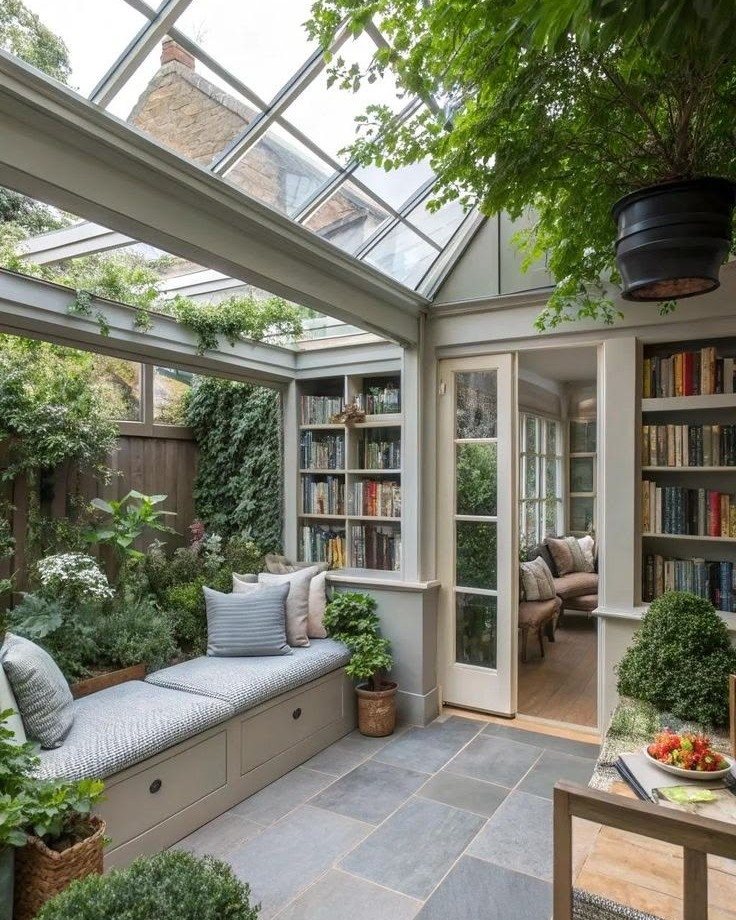
Room garden ideas run from a terra cotta pot on a windowsill to a full greenhouse build, and the one that fits depends on whether you rent or own, how much sun your space gets, and whether you have a weekend or a whole season.
1. Fill It with Plants

A room garden starts with living things, and the quickest way to make it feel like one is to pack in plants at every height. Tall ones draw the eye up; trailers soften edges.
I would check the light first, then buy: a south-facing wall handles fiddle leaf figs and bird of paradise, while a dim corner wants snake plants, ZZ plants, or pothos that tolerate neglect. Ferns and palms fill the middle ground.
The mistake I see most is buying one of everything and hoping it works; better to get 3 of the same pot and repeat the shape.
2. Use Naturalistic Planting

Letting plants grow messy takes more nerve than keeping them tidy, but a room that feels found rather than arranged is worth it. The wild look suits renters who can’t hardscape and first-home owners still building beds outside.
I let my ferns spill over shelves and my pothos run until I trim them back twice a year. Choose plants that want the same water and light so nothing dies for the sake of the look.
Skip topiary and rigid rows; clump things in odd numbers and let leaves overlap.
3. Use Vertical Planters

Wall space is free real estate when floor space runs out. A slatted wood frame with pocket planters turns a blank wall into a green screen without eating square footage you don’t have.
I mounted one on my rental’s balcony using a French cleat so it lifts off when I move; the landlord never knew it was there.
Herbs do well in the top rows where sun hits, and shade-lovers like calathea or alocasia fill the lower pockets. Water drains straight through, so plan for a tray or let it hit ground you don’t mind getting wet.
4. Add a Fire Pit

Stone or metal, gas or wood, a fire pit pulls people outside on nights they’d otherwise stay in.
A built-in ring with gravel surround and pergola overhead is the permanent version; I started with a steel bowl on legs and moved it with me. Wood gives smoke and crackle, gas gives instant flame and no ash.
For a rental, the portable kind wins. Check local burn ordinances before you buy; some towns ban open wood fires but allow gas, and the fine for guessing wrong stings.
5. Add a Water Feature

Running water covers traffic noise and cools the air by a few degrees, which matters more than I expected before I tried it.
A small recirculating fountain runs off a plug and needs no plumbing; I set one on my patio and moved it inside come November. Start with the plug-in kind.
Mosquitoes breed in still water, so keep the pump running or add mosquito dunks. The sound of it is what you pay for; the rest is maintenance.
6. Choose Functional Flooring

The floor takes more abuse than any other surface in a garden room, and the wrong choice shows its age in 2 seasons. Cheap composite decking warps where sun hits, so I would not use it again in full exposure.
Now I check three things: will it handle standing water, will it fade, and can I replace one piece without tearing up the rest.
Stone or brick lasts but costs; concrete pavers split the difference; dense-patterned tile hides scuffs and reads cheerful in a small space. Match your hardscape to what the house already uses outside.
Too many materials in one view looks like a yard sale, not a room.
7. Use Salvaged Materials

A door from an old farmhouse now holds up clematis instead of a screen door latch. Salvaged pieces carry instant texture that new wood spends years trying to fake.
I look for doors, windows, and old furniture at estate sales and Habitat ReStores, usually paying pocket change for a solid piece. Check for rot at the base; a little weathering looks right, but soft wood crumbles fast.
Vintage metal tubs and grape harvest baskets work as planters if I drill a drainage hole first.
This suits renters best: you take the character with you when you leave. A solid pine door needs help to move and a brace set in concrete to stand steady.
8. Create a Wildlife Zone

A hanging nest woven from leaf litter and grass stems means some bird found your yard worth the risk. That happens when you stop mowing every edge.
I set aside a corner with native shrubs, a shallow water source, and a brush pile I add to each fall. The water needs cleaning weekly in summer; mosquitoes turn a birdbath against you fast.
Native plants matter more than variety; one solid patch of serviceberry feeds more caterpillars than a row of exotic bloomers.
This idea trades neatness for life. The brush pile looks messy to some eyes, and you will find spiders in unexpected places.
I’d put this near a window you pass often; the payoff is watching, not just knowing.
9. Add a Small Patio

Stone pavers on compacted sand give a garden room its floor without a concrete truck or permit.
I clear the sod, lay landscape fabric, then level paving sand before setting stones. Gravel or mulch between pavers locks them and handles the gaps.
A path from the house to this spot matters as much as the patio itself; walking on lawn defeats the purpose.
A small patio space takes a weekend and scavenged stone keeps the material cost low. The limit is frost heave in cold zones; sand base shifts more than concrete, so I check level each spring and tap stones back flat.
10. Add a Trellis or Arbor

Vertical structure changes how a flat yard reads.
I build these from cedar posts set in concrete, with crosspieces notched and screwed on top. Climbing roses or clematis need deep soil at the base, so I plan the post holes around that.
For faster coverage, morning glory or sweet pea seeds are cheap and climb in one season.
An arbor trades open sky for enclosure; a small yard can feel smaller. I’d skip it if the garden is under 15 feet deep, unless the goal is hiding something specific, like the neighbor’s garage wall.
11. Incorporate a Dog Run

Artificial turf in a narrow side yard keeps small dogs busy without turning grass to mud.
I fence the run with wire mesh sunk below grade; diggers test every perimeter. The surface choice depends on drainage: turf needs a gravel base and cleaning spray, while pea gravel lets urine pass through but shifts under paws.
Shade is non-negotiable; I add a tarp sail or the space bakes unused in July.
This suits active breeds in small lots. The downside is smell on turf, and the upfront cost runs higher than seeding lawn.
I’d check my HOA first; some ban visible kennel structures outright.
12. Add a Children’s Garden

Blue raincoats and a mud kitchen mean these kids are not keeping clean, which is the entire point.
A children’s garden gives them dirt, sticks, and water to move between containers, the same tools adults use minus the pressure to produce.
I designate a corner with shade, a hose spigot nearby, and plants that can take trampling. Lamb’s ear and nasturtium recover from small feet; tomatoes and strawberries do not.
The mud area needs a border of logs or stone to contain the spill, and I accept that raincoats become standard equipment.
This idea trades lawn perfection for laundry volume. It suits small children best; older kids want ball space or hideouts instead.
I’d locate it where I can see from a kitchen window, not tucked behind a garage where supervision means walking out.
13. Incorporate a Herb Garden

Fresh herbs on a kitchen counter beat dried ones in a jar every time. A windowsill or a narrow counter strip gives you basil, parsley, cilantro, or thyme within arm’s reach of the cutting board.
Terra cotta pots drain well and cost little; a white tray underneath catches runoff and keeps the counter clean.
Light makes or breaks an herb setup; scout your spot at midday and again near evening to see what actually hits it. No south-facing window?
A small LED grow bulb on a timer fixes dim corners without rewiring anything.
Water when the top inch of soil dries, not on a schedule. Overwatering kills more herbs than underwatering.
Scale is the real limit; a windowsill fits a few pots, not a full pantry’s worth.
14. Add Plenty of Textiles

Garden rooms feel hard until you soften them. Outdoor-rated cushions, throws, and a rug underfoot turn a glass box into somewhere you actually want to sit.
The fabric matters more than the pattern. Solution-dyed acrylic or olefin survives UV and rain; in a well-insulated room with proper glazing, decent indoor textiles hold up too.
A DIY rug from bound carpet remnants fits odd corners custom-sized without the custom price.
Skip this if your garden room leaks or lacks heat; damp destroys indoor fabrics fast. For dry, sheltered spaces, textiles are the fastest, cheapest warmth you can add.
15. Create a Pantry Space

A garden room with a door to the yard makes a practical pantry. You haul tomatoes in from the vine and set them on the shelf; no tracking dirt through the kitchen.
Open shelving turns pantry storage into something you actually use; when jars sit out, you remember what you have. Old wooden crates stack to whatever height you need, found at flea markets for a few dollars each, sizes mixed.
Wire baskets below the counter suit the produce that wants dark and air.
A microwave tucked in means reheating without the main kitchen, handy during canning season or big cooks.
This needs a dry, cool room; damp ruins dry goods. No insulation?
Stick to canned and jarred, skip the flour.
16. Considered Dining

A garden room with a table turns brisk evenings into dining weather. A stone lounge mixed with a wood dining set, color against neutral; the same pairing works inside glass walls too.
Rustic pieces piecemeal together fine. A table base from Marketplace, chairs recovered from a thrift store, a glass top found curbside: the mismatch becomes the look.
One unifying element holds it together, usually the finish on the wood or the color of the cushions.
Running power for heat and lighting stretches the season. Without it, this is a 3-season room at best, fine in the South, short in Minnesota.
I’d build this for hosts who cook for groups but lack a formal dining room. Distance from the kitchen is the real cost; plate on a tray or commit to a butler’s pantry setup.
17. Creative Lighting

Light determines whether your garden room gets used after dark. LED strips along a path do two jobs: they keep people from tripping, and they make the space feel intentional, not leftover.
Inside a glass structure, hang fixtures outside the glass to reflect in, doubling the glow without glare in your eyes. Battery candles in a hanging cluster, looped between branches or a beam, give flicker without fire risk.
Path lights need to be bright enough to walk by; uplighting trees or a statue needs only to cast shadows. Mix the two and you get depth.
Solar sticks work where wiring won’t reach, though they fade by midnight.
Budget move: start with one string of warm white LEDs and add from there once you see where the dark spots stay. Cold light reads as security; warm light reads as invitation.
18. Garden Room Walls

Walls in a garden room don’t have to be drywall. A driftwood branch hung with glass jars by twine turns vertical space into a living surface without a single nail in the plaster.
Vining plants in hanging pots trail down; compact varieties sit on shelves; upright floor specimens fill corners. Three heights minimum stops the eye from reading everything as one flat plane.
A wall hook rated for more than a full watering can holds more than you’d think, but check your anchor.
For outdoor garden rooms, hedges or espaliered fruit trees make living walls. Fences, stone stacks, or the existing wall of a garage give structure for nothing if you already own the boundary.
Rope and driftwood cost little, the jars less, and the plants propagate from cuttings. This suits the renter who can’t renovate and the owner who’d rather garden than build.
19. Potting Room

A potting room gives dirt and tools a home so the rest of the house stays clean.
The bench is the center of it: a wooden surface at hip height, with a shelf below for bags of soil and a row of baskets above for hand tools, gloves, and labels.
A deep sink nearby handles the muddy work. I would set the bench under a window if the room has one, since seedlings need light and the gardener needs to see color true.
The same bench, cleared of pots and soil, works fine as a serving table when company comes. That dual use matters in a small house where every room earns its keep.
20. Incorporate Outdoor Furniture

Outdoor furniture in a garden room makes the wall between inside and out harder to notice, which is what the space is for.
Choose pieces that can actually handle sun and rain without turning into a maintenance project: resin wicker, powder-coated aluminum, or solid teak if the budget stretches.
Bright cushions and patterned fabrics read as garden even when the set lives in a conservatory through winter.
I like hanging chairs or a small swing for the corner nobody knows what to do with; they turn a dead spot into the place people fight over. Check the frame weight before ordering anything that needs to move seasonally.
21. Incorporate a Greenhouse

A greenhouse lets you start seedlings while frost still hits outside and keep tomatoes going past the first cold nights, which in a cold climate pays back every dollar.
Either way, site it where it catches morning sun and afternoon shade; too much heat cooks seedlings faster than cold kills them.
Plant Selection
Light dictates what lives, so I start there. A south wall gets the drama plants: fiddle leaf fig, bird of paradise, anything that wants direct sun most of the day.
East or west windows suit the middle ground, ferns and palms that take filtered light. North-facing or deep interior corners get snake plants, ZZ plants, pothos, the ones that forgive weeks of neglect.
Seasonal change matters more in a garden room than a living room. Deciduous vines on a trellis give summer shade and winter sun through bare branches.
Evergreen shrubs hold structure when everything else drops leaves. I would plan for at least 1 plant per 10 square feet that stays green in January, or the room goes dead for 3 months.
Color comes from flowers and foliage both. A purple tradescantia or a croton with red and gold leaves reads as color without waiting for bloom.
I treat the room as a border that happens to have walls.
Creating Privacy
Privacy in a garden room works in layers, not walls. A hedge of arborvitae or privet takes 3 years to fill in but lasts 20; a fence goes up Saturday and looks like a fence.
I would mix them: hedge at the property line for sound, a trellis or old door panel closer in for the feeling of enclosure.
Lattice panels let air through and cast shadow patterns; solid fencing blocks wind too and can feel boxed. Curtains of waterproof fabric on a wire or rod soften hard edges and draw back when you want the view.
An old door, stripped and sealed, makes a screen with character that moves with you if you rent.
The layout matters as much as the barrier. A path that turns before reaching the seating area delays the reveal; a straight shot from house to chair feels exposed no matter what you plant.
I’d put the most private corner farthest from the house, where guests arrive last and stay longest.
Incorporating Furniture
Outdoor furniture migrates inside better than the reverse. A metal dining set or a painted bench built for rain handles the humidity of a glass garden room without swelling or molding.
I look for pieces that could sit on a patio and not look wrong; that toughness translates.
Egg chairs and hanging swings add motion and a sense of retreat. They need a beam or bracket rated for the load, which is more than a potted plant.
I would check the hardware twice before trusting my weight to it.
Multifunctional pieces stretch small space. An ottoman with storage holds cushions dry; a bench with a hollow seat keeps potting soil handy.
Bright colors and patterns against green read cheerful; too much wood or wicker goes muddy against plants. One vivid piece, a painted table or a striped cushion set, anchors the room better than matching sets that try too hard.
Frequently Asked Questions
What is a garden room?
A garden room is a defined outdoor space built for a specific function, with its own floor, walls, and ceiling like any indoor room.
The walls might be hedges, fences, or the side of a garage; the ceiling could be tree canopy, a pergola, or string lights overhead. It creates privacy and intimacy in a yard that otherwise reads as one open lawn.
What are some ideas for a cozy garden room?
Cushions and throws in outdoor-rated fabric soften hard surfaces faster than anything else, and a rug underfoot turns decking into somewhere you want to sit. The cozy part is the layering: hard structure first, then plants, then textiles, then light.
What materials are best for garden rooms?
For floors, stone or brick lasts but costs; concrete pavers split the difference; dense-patterned tile hides scuffs in small spaces. I would not use cheap composite decking in full sun, having watched it warp.
Overhead, I like options that don’t need a building permit: a pergola with something climbing up it, a shade sail in a tough fabric, or just string lights hung where a tree canopy isn’t doing the job already.
What is the best plant to keep in a room?
That depends on the light you actually have, not the light you wish for. For a room garden, I’d pick pothos as the safest starting bet: it survives low light, irregular water, and still trails softening edges.
What are some ideas for a simple indoor garden?
A kitchen windowsill with terra cotta pots of basil, parsley, and thyme is the simplest start; a white tray underneath catches runoff.