Outdoor furniture fabric ideas run from a yard of canvas to custom slings that eat a whole Saturday, and the deciding factor is not budget but whether you own the frames or the freedom to store things indoors.
Renters with closet space gain the most from floor cushions that stack flat and move inside; homeowners with solid lounger frames keep the metal and swap the fabric.
The proving detail is in the numbers: reupholstering one standard chair seat takes a single yard and a pneumatic stapler, while a deckchair sling demands half-inch precision and a grommet kit to avoid wrinkling that tears the weave.
1. Floor Cushions

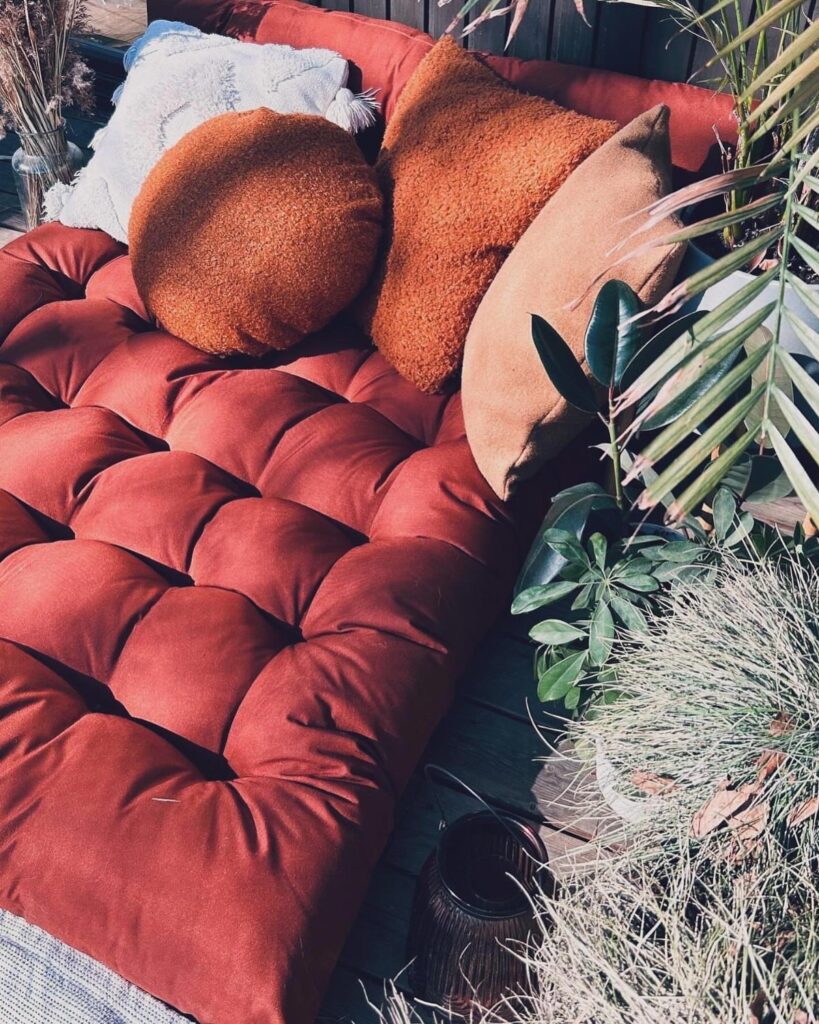
Large floor cushions turn a bare deck or patio into seating without hauling furniture through a doorway. Tufted cushions thick enough to sit on directly also stack into a low table for drinks.
Outdoor-rated foam and fabric matter here more than looks. Standard upholstery soaks up rain and mildews; high-performance outdoor fabric lets you brush off leaves and hose off spills.
I would check whether the cover zips off for washing before buying, since ground-level cushions pick up dirt fast.
This suits renters best. You gain flexible seating you can store in a closet all winter and move to the living room when indoor space runs short.
2. Deckchairs and Loungers

Striped deckchair fabric fades fast if it is not solution-dyed, so replacing the sling is often smarter than buying new frames.
Custom slings need precise measuring. The fabric wraps around a dowel or bolts to the frame at each end, and half an inch of error means wrinkling or tearing.
I would order a small swatch first, test the tension, then cut the full piece.
This project takes an afternoon and a staple gun or grommet kit. It suits anyone whose frames are solid but whose fabric has gone chalky or torn at the stress points.
3. Canvas Fabric

Canvas looks right on porches where slick synthetics would feel wrong. Heavy canvas shows a visible weave in white, orange, and brown stripes that reads as natural rather than plastic.
Water is the real weakness. Canvas resists sun and abrasion well, but rain soaks through unless you treat it or buy factory-coated yardage.
I would plan on re-treating every 2–3 seasons if the piece sits uncovered.
Use it for cushions that live under a roof, or for canopy panels where breathability matters more than absolute dryness. Tents and cabana curtains are the classic fit; for open-yard seating, a coated backing or quick-dry foam insert helps.
4. Custom Table Linens

A tablecloth in outdoor fabric lets the table stay set between meals without worrying about morning dew or a spilled pitcher. Blue and white patterns coordinate with garden greens without fighting them.
Custom sizing fixes the outdoor-table problem: standard linens hang too short on picnic tables or drag on bistro-height ones. I would measure the top, add the drop you want, and add a little extra all around for hemming shrinkage.
Machine-washable outdoor fabric matters here more than for cushions, since food stains are the whole point. Napkins in the same yardage tie the look together; embroidery adds a step but marks the set as yours.
5. Outdoor Curtains

White curtains turn a covered porch into a room that happens to lack walls.
Outdoor curtain fabric needs to resist UV, mildew, and the occasional splash from a hose or rain blow-in.
A grommet top on a galvanized rod holds up better than a pocket on a wood pole; I would check that the rod is pitched slightly outward so water runs off rather than pooling.
The maker of this installation noted they have held up for 8 months so far. That is a useful benchmark for how coated polyester weathers in real use.
6. Reupholstering Furniture

A pneumatic stapler and a yard of fresh fabric turned this worn chair seat into something that looks intentional. Light blue replaced whatever pattern had gone sun-bleached or torn.
Reupholstering a simple chair goes fast once the old fabric is off. Pull the new piece tight, staple from center to corners, and trim underneath.
Start with enough fabric; one yard covers most standard seats, but a wide or deep chair might need more.
This is the cheapest way to rescue a set that wobbles only in appearance. I would check the frame and straps first; new fabric on a sagging seat lasts one season.
Caring for Outdoor Fabrics
Mild soap and water handle most outdoor fabric cleaning. Harsh chemicals strip the coatings that make fabric water-resistant, so I stick to dish soap and a soft brush.
Storage matters as much as washing. Cushions left out all winter collect moisture even under a cover; I store mine in a closet or garage if I have the space.
At minimum, I stand them on edge so water runs off rather than pooling underneath.
Sun damage shows up as brittleness before it shows as fading. Rotating cushions every few weeks keeps wear even, especially on pieces that sit in the same spot all season.
Remember to store upholstered cushions inside when you’re not actively using them, hose down the fabric once in a while, and even take bleach to it for more serious stain-elimination projects. “Typically, it’s a 1-to-4 ratio of bleach and water.
Choosing Outdoor Fabrics
Water resistance, UV resistance, and durability are the three properties worth checking for. A fabric can look great and still fail on one of these.
Water resistance keeps rain from soaking through to foam or padding. I look for fabric rated for outdoor use rather than water-repellent sprays added after the fact.
UV resistance matters even in northern climates. Sun breaks down fibers over time; without UV stabilizers, a bright color goes chalky in one season.
Durability covers abrasion from getting in and out of chairs, plus the stress of wind flapping loose fabric. Tighter weaves and solution-dyed fibers hold up longer.
Color Considerations
Lighter colors reflect sunlight and resist fading longer. White, beige, and pale gray stay truer over seasons of direct sun.
Darker colors hide dirt better. Charcoal or navy looks cleaner between washings, though they absorb more heat in full sun.
Beige, gray, and taupe stay quiet through trend cycles and still look intentional ten years later. I would pick these for pieces I plan to keep long-term.
Sunbrella’s catalog runs heavy on blues, greens, and earth tones. Basic solids run closer to entry-level pricing, while printed patterns with more complex weaving jump to the upper end of the range.
That spread lets you match budget to project; a few throw pillows in a $87.95 print on a base of $41.95 Canvas Navy stretches the look without stretching the cost.
Fabric Types Comparison
Sunbrella, olefin, and vinyl-coated fabrics all hold up to daily sun and rain without breaking down quickly. Each fits a different situation.
Sunbrella is a solution-dyed acrylic. It resists fading and mildew well, and it comes in the widest range of colors and patterns.
I would use it for cushions and slings where appearance matters.
Olefin is a polypropylene fiber. It repels water naturally rather than relying on a coating, so it does not lose performance as the finish wears.
It costs less than Sunbrella and works well for budget projects or pieces that sit covered most of the time.
Vinyl-coated fabric is the most weatherproof of the three. Rain beads up and wipes off; it is the choice for boat covers and pieces that stay out in all weather.
It comes out stiffer and traps more heat, so I would skip it for deep lounge chairs and save it for dining seats or backs that see lighter use.
Frequently Asked Questions
What is the best fabric to use for outdoor furniture?
Solution-dyed acrylic like Sunbrella and high-performance olefin hold up longest against sun and mildew. For slings and curtains, look for UV resistance and a weave tight enough to keep its shape through wet seasons.
What fabric is like Sunbrella but cheaper?
Olefin is the usual alternative. It resists UV and moisture well at a lower price point, though it may not last the 10–15 years Sunbrella can with proper care.