
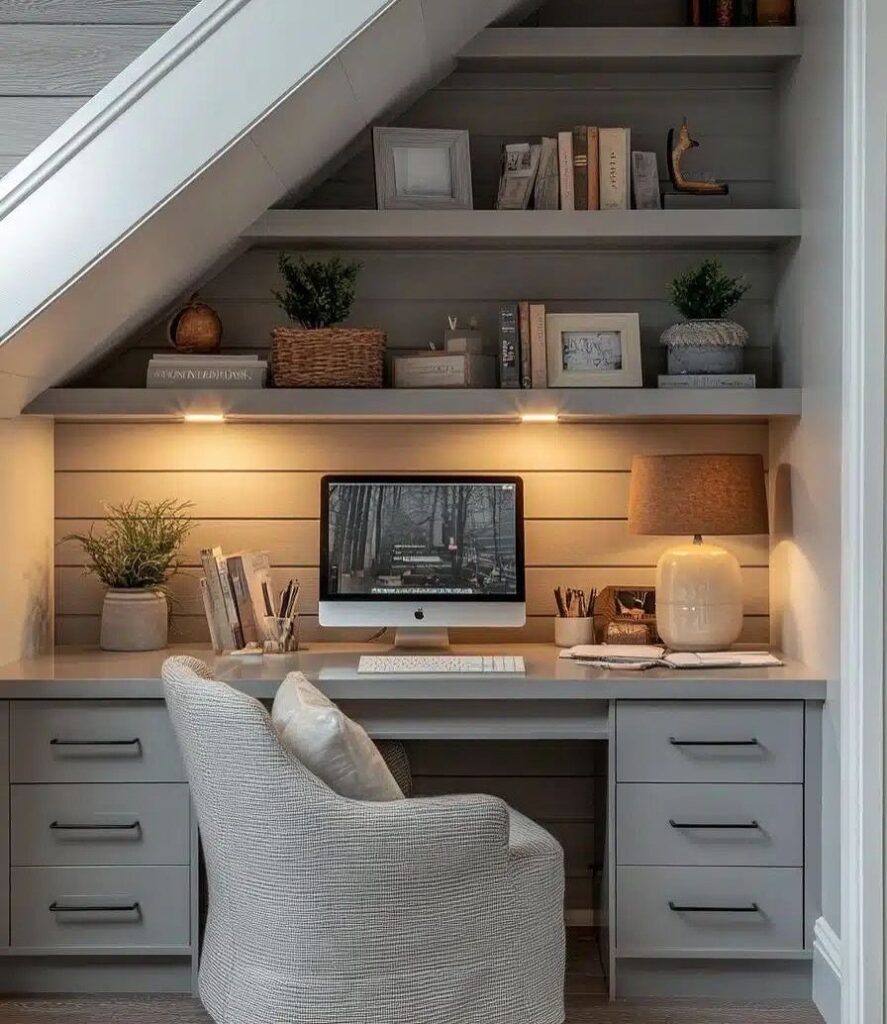
These ideas run from a pegboard and paint up to custom millwork, and the one that fits depends on whether you own the staircase or just the space beneath it.
Renters leaning on modular shelving and wall-mounted organizers can still get a functional desk; owners replacing the whole stair can build the storage into the structure itself.
The Japanese-style alternating treads with cubbies show how far the concept can go when the stairs themselves are part of the project.
1. Built-in Shelves
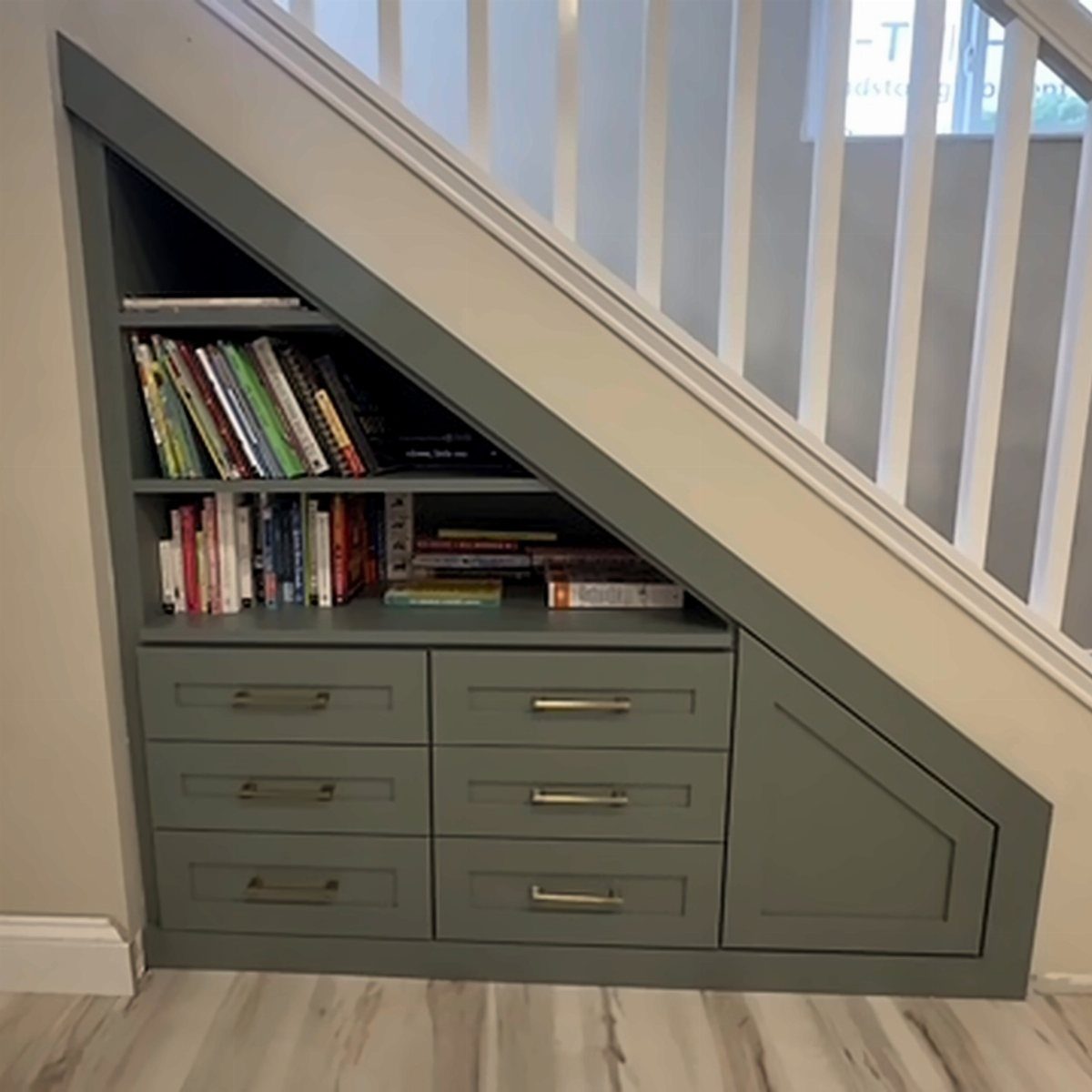
Gray built-ins with open shelves above and drawers below turn the triangle under a staircase into usable wall. The slope decides your shelf heights: shallow up top for paperbacks, deeper down low for binders or baskets.
I like mixing open storage with a few closed drawers because mail and cords disappear while books stay reachable. If you rent, a modular shelving unit cut to the angle gets you close without construction.
This one suits anyone who collects physical stuff and wants it visible but corralled. Open shelves collect dust fast; skip them if wiping ranks low on your tolerance list.
2. Home Office Nook
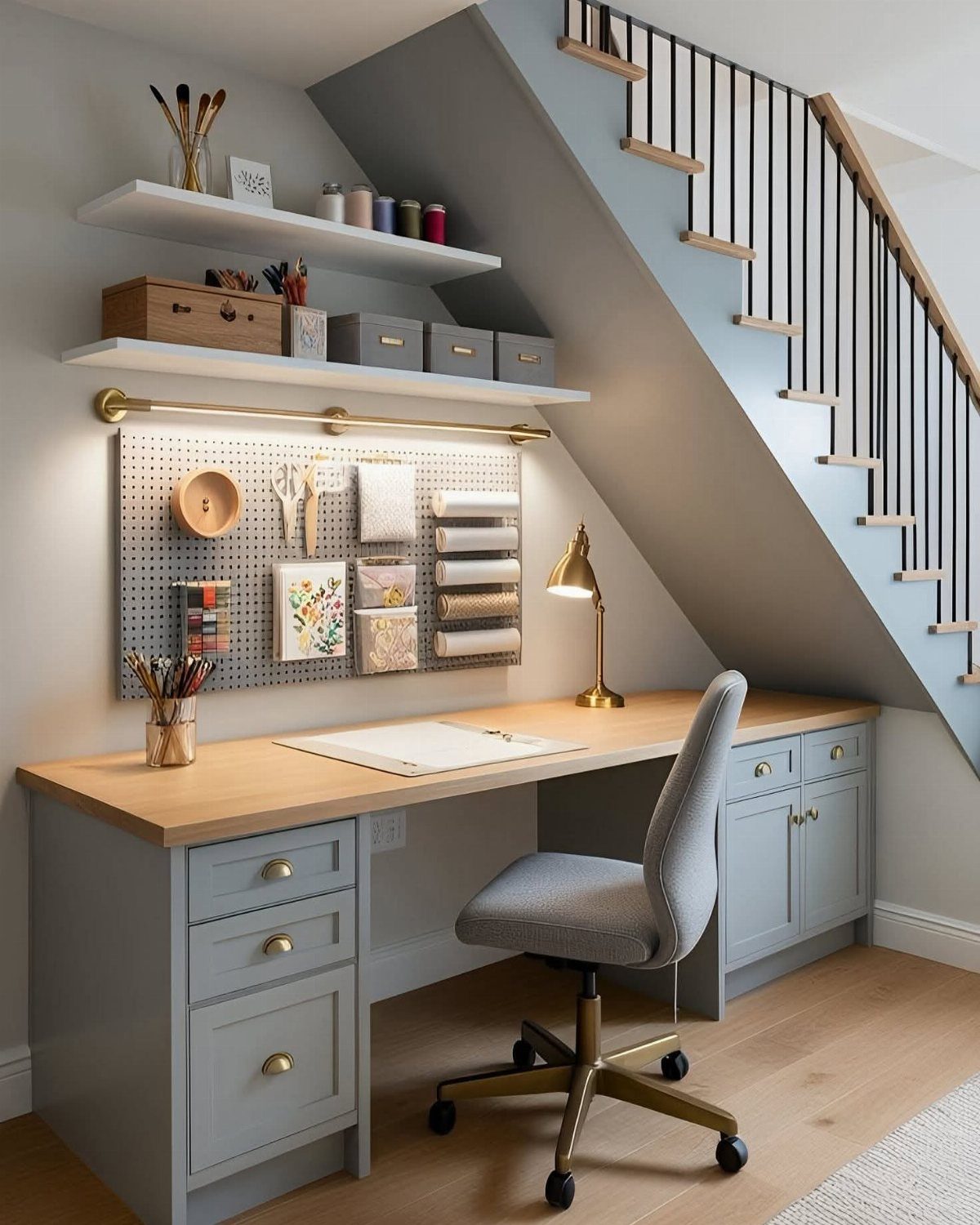
A desk built into the short wall, chair tucked under the tallest part of the slope, turns awkward geometry into a real workspace. Light blue drawers against wood keep the palette calm enough to focus.
Pegboard and floating shelves above the desk claim the vertical space your legs never reach. I would face the desk into the deepest corner, not out toward foot traffic, since the stair overhead already encloses you.
Renters can fake this with a narrow desk slid under the stairs and a wall-mounted pegboard. Best for someone who needs a daily desk and cannot spare a whole room.
Turn the wall under the stairs into a pretty and practical home office. This modern WFH nook by designer Lindi Vanderschaaf seamlessly blends in with the rest of the space.
3. Personalized Decor
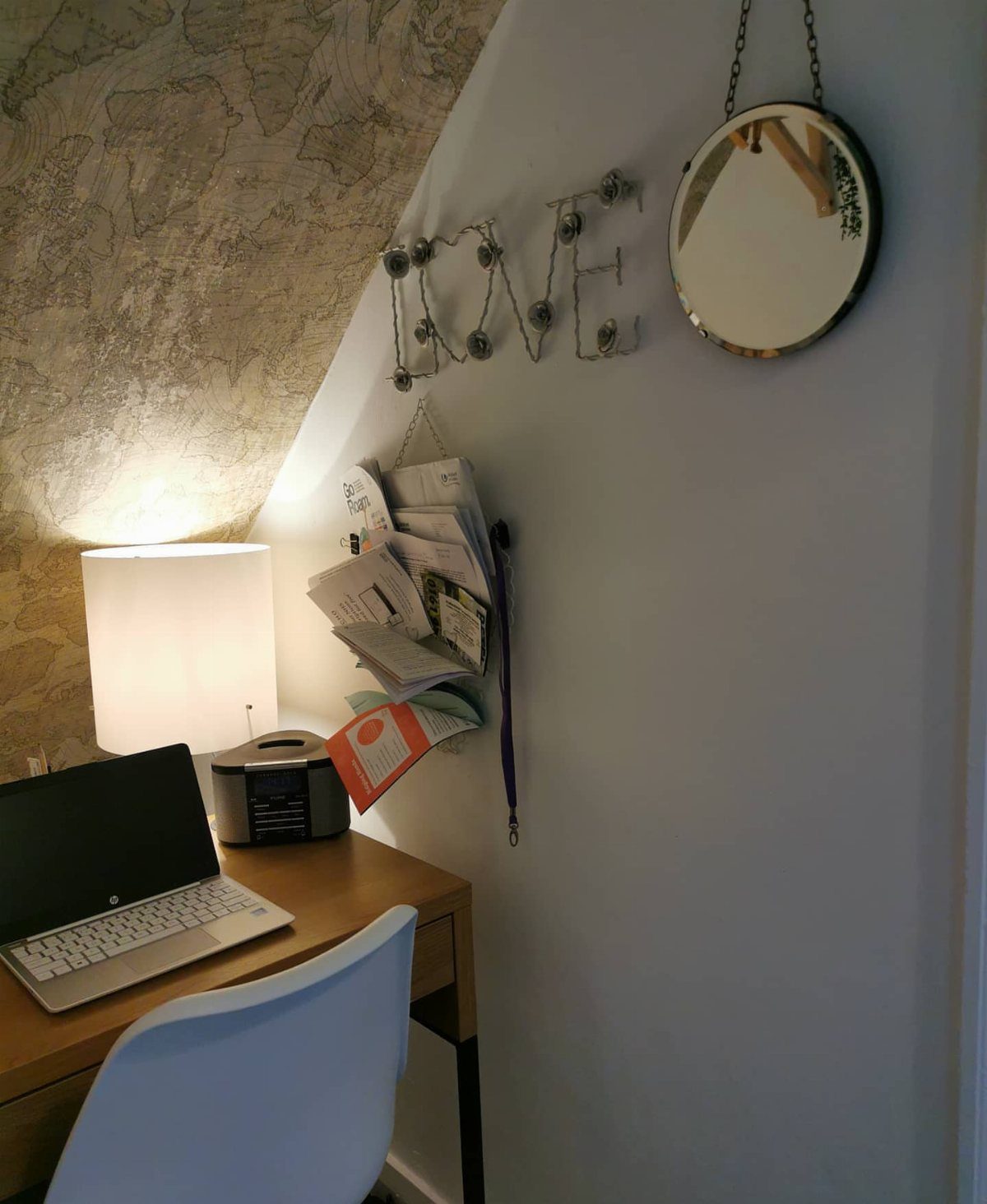
Map paper on the sloped ceiling makes this nook feel intentional rather than leftover.
Small spaces flatten into boredom fast; one bold surface treatment plus a few things you already own fixes that. I would limit myself to two or three personal items so the desk stays clear for actual work.
This approach costs little and moves with you. It suits renters or the chronically indecisive, since nothing is permanent.
The risk is clutter; edit hard if your stuff tends to multiply.
4. Japanese-Style Staircase Storage
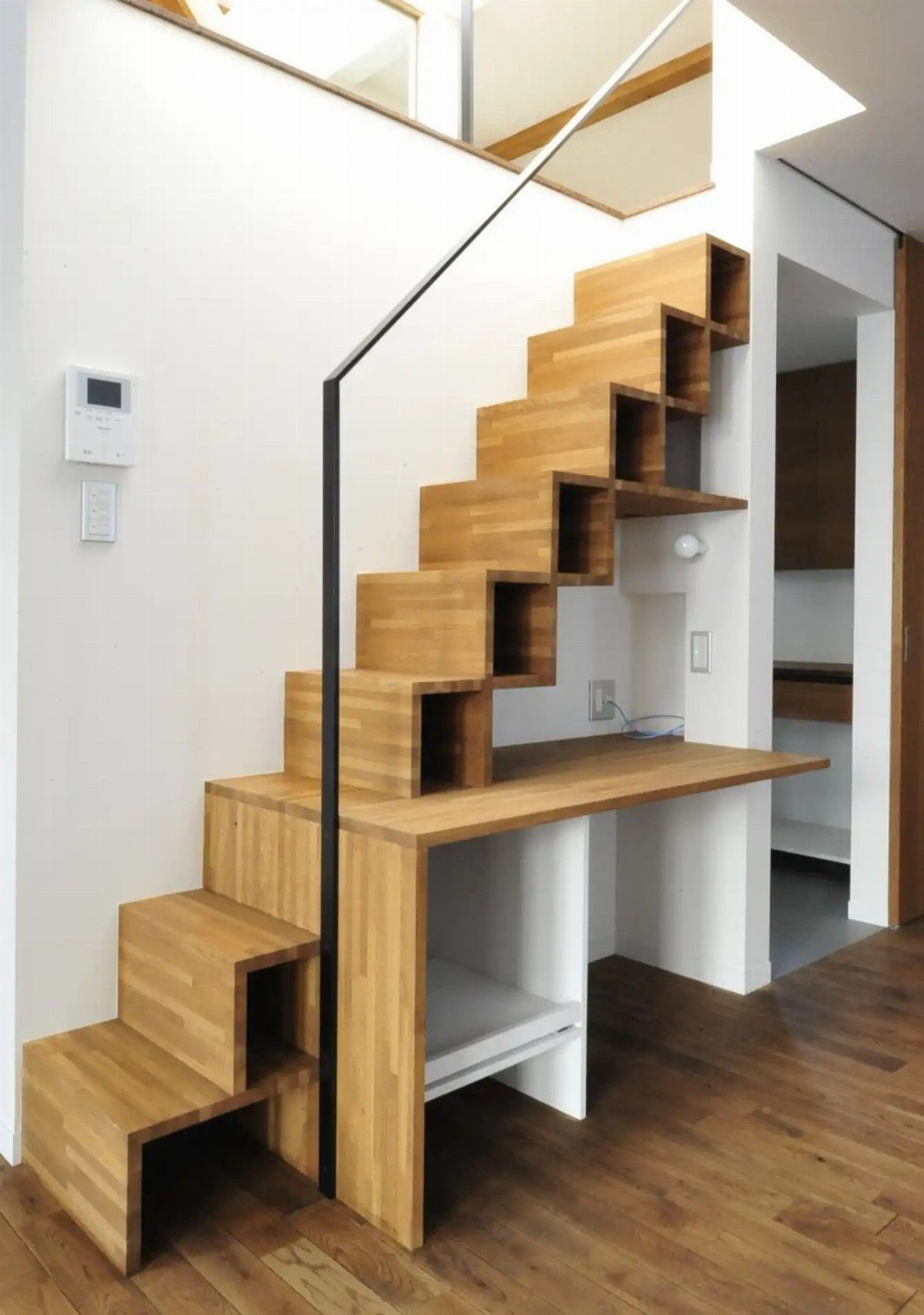
Alternating treads with cubby shelving built into the structure itself turn the stairs into the storage. A desk surface attached to the side claims the wall beneath for work.
The open cubbies keep supplies visible; linden plywood and ash treads warm up the white surround. I would add small bins if the openness started to look messy, though the Japanese originals left everything exposed by design.
This level of finish takes real joinery and more than a couple of days. It suits new builds or major renovations where the staircase itself is being replaced.
The stairs themselves eat more rise per tread to buy that storage underneath; the first few trips feel like climbing a ladder.
5. Floating Desk
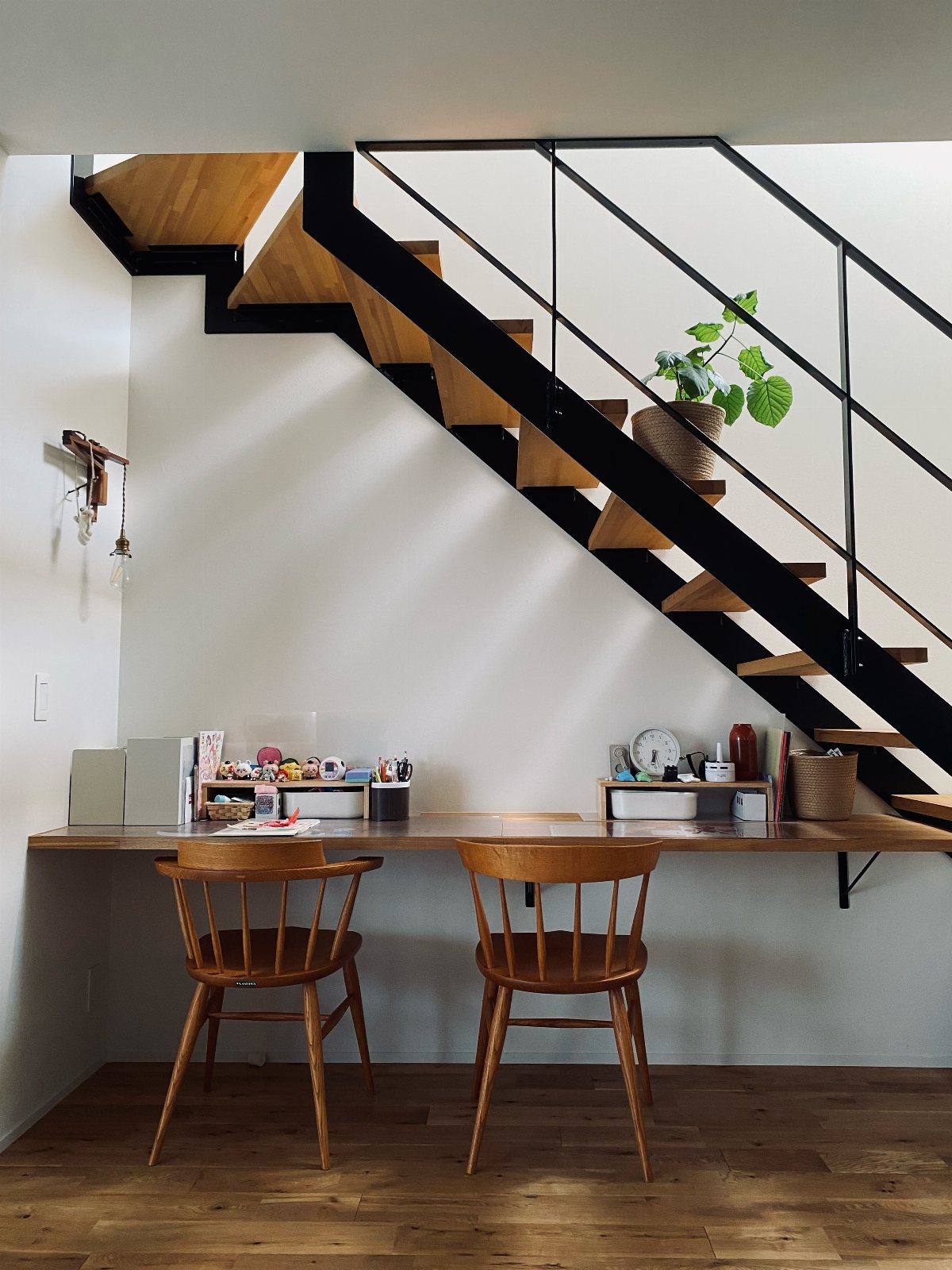
Two chairs fit because the desk runs long, not deep.
Anchor into studs; the cantilever carries weight only if the bracketing is right. I would keep the surface shallow front to back so knee room does not disappear where the slope tightens.
This works for laptop work, not for spreading blueprints. Best for households that need a second workstation briefly, not someone parked there all day.
Add a small rolling drawer unit if you need more than the surface holds.
6. Desk with Storage
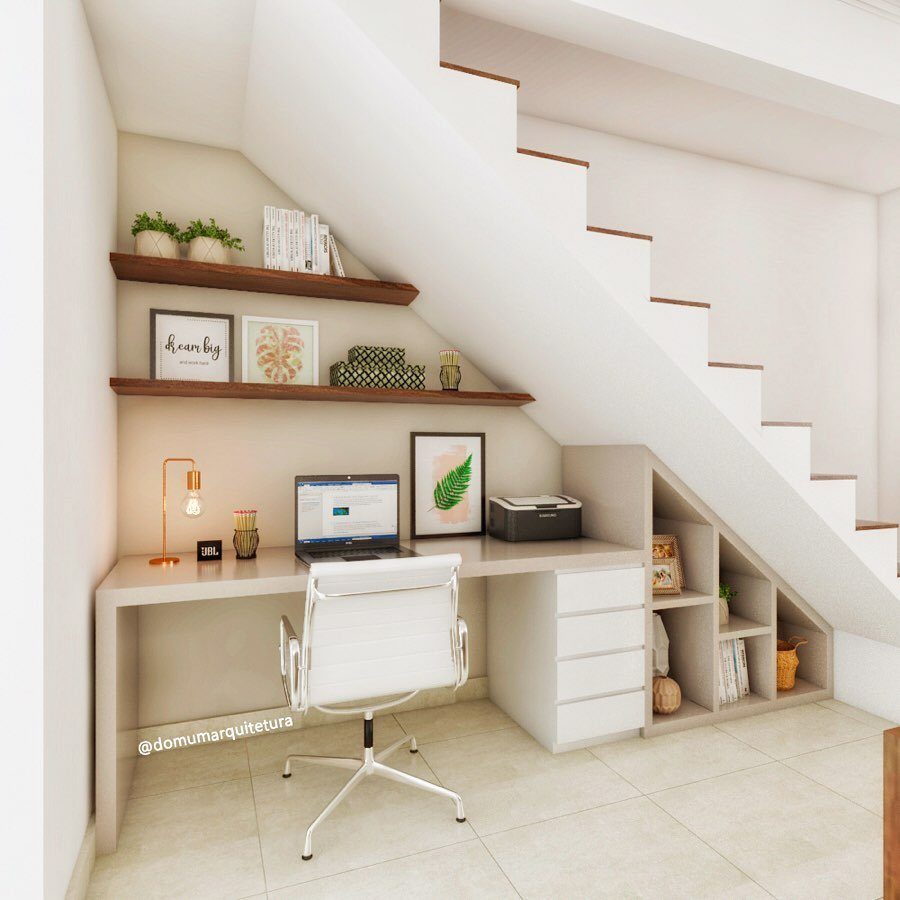
Drawers in the desk, cubbies under the lowest treads, and floating shelves above turn one triangle into a full office system. White on white keeps the parts from feeling stacked on top of each other.
Built-in millwork claims every odd inch that a freestanding desk would waste against the slope. Custom work starts around $1,500 and climbs with materials; a prefab desk plus wall shelves gets you partway there for less.
The commitment is the cost; the gain is never hunting for another place to put the printer.
7. Wall-mounted Organizers
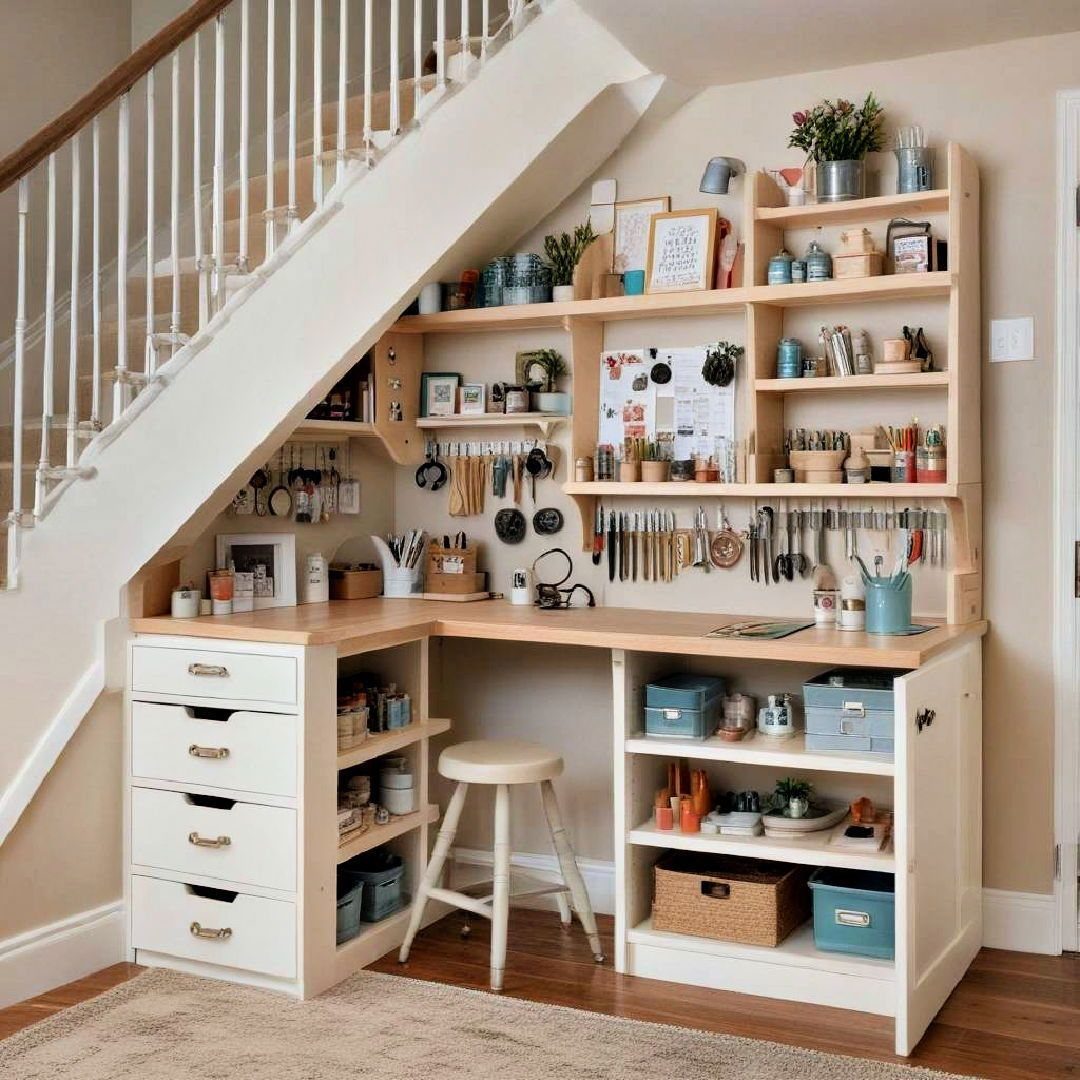
Vertical space is the only space most under-stair offices have in any real amount, and wall-mounted organizers treat that narrow wall like square footage you forgot you owned.
Pegboards and shallow shelves keep pens, small containers, and tools off the work surface entirely, which matters when the desk itself is barely deep enough for a laptop and a coffee cup.
A pegboard system runs about the cost of a takeout dinner for two, or you can build a French cleat rail in an afternoon with a table saw and a few feet of pine.
Paint the wall a pale color before anything goes up; light bounces around a windowless nook better than in a normal room, and once the desk and shelves are in, you will not want to tape around them.
This setup suits anyone whose under-stair space is more alcove than room.
It trades away the clean, hidden look of closed cabinets for instant access, which is the wrong trade if you are trying to make the office disappear behind a door.
For a craft-heavy user or someone who switches tasks often, though, having every tool visible beats digging through drawers every time you need a different pair of scissors.
Preparation for Under-stair Office
What counts is the clearance directly above your head while seated, not the tallest point of the space. The opening needs 30 to 36 inches for chair access and so the nook does not feel like a crawl space.
Lighting Considerations
Plan for layers.
One table lamp will not be enough. If the stairs have risers you can remove, doing so pulls more light through from the rest of the house.
A separate window is the best fix where the structure allows it, though that crosses from weekend project into real construction.
Air Circulation
Air movement in an under-stair nook tends toward stale and warm, since the staircase overhead traps rising heat and the enclosed sides block cross-drafts.
Keeping the space open to the room, rather than walling it in with a door, lets the house’s normal circulation do the work.
Where the layout already closes it off, a small vent fan or a duct run to the nearest return helps.
I’d rather over-ventilate than sit in a pocket of still air; a cheap desk fan is the minimum, and it is not enough for summer afternoons if the nook is tucked against an exterior wall that gains sun.
Cost Considerations
A light refresh, paint and a freestanding desk plus better lighting, runs $300 to $1,500. Premium lighting or a nicer desk pushes the top of that range.
Built-in millwork with added outlets and hardwired lighting lands at $2,000 to $6,000. A full conversion, closet or bath demo, rewiring, data drops, and new flooring, starts around $6,000 and can pass $12,000.
Get competitive bids on that scope to find out what the work actually costs in your area.
Frequently Asked Questions
What is the average cost of under stairs storage?
Custom millwork for an under-stair office starts around $1,500 and goes up from there depending on materials. A ready-made desk and some wall-mounted shelves get you most of the way without the custom price tag.
What you spend comes back as daily convenience; the printer finally has a permanent home instead of migrating around the house.
What is the best storage option for under the stairs?
Custom millwork that follows every angle of the staircase squeezes more use out of the space than anything you can roll in from a store.
Open shelving keeps books and notebooks within arm’s reach; a drawer or two in the mix hides the mail pile and the power strip tangle.
Renters can get a similar effect by trimming a modular shelving unit to match the stair slope, no nails in the wall required.
What are the NFPA guidelines for storage under stairs?
Keep combustible storage away from the underside of stairs; local fire codes treat this as an enclosed space, so paper stacks and chemical containers belong somewhere else.
Readers concerned about code compliance should consult their local building department or a licensed contractor, since requirements vary by jurisdiction and by whether the stairs serve as an exit path.





